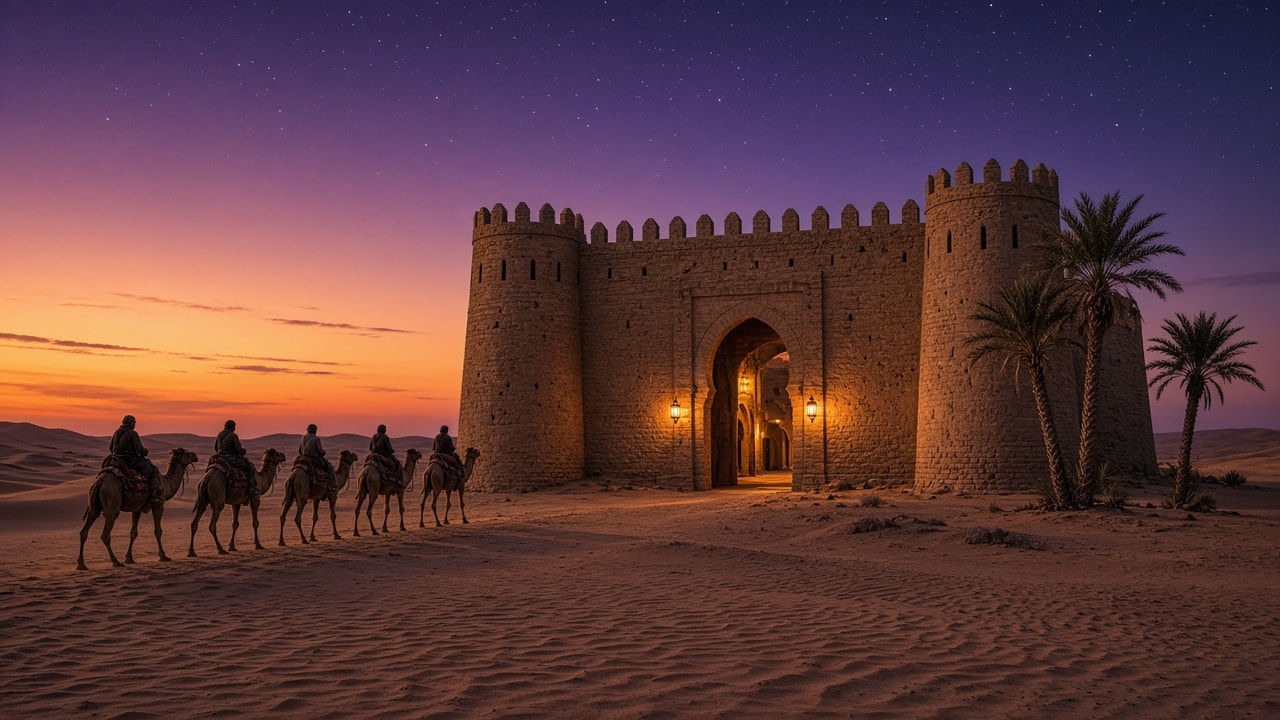
Photoreal dusk shot of a square sandstone caravanserai with two round towers and a lantern-lit arched gate, five camels with riders walking toward it across rippled sand, three palms by the right tower, and an orange-to-violet starry sky. Step 2 of the Desert Caravanserai workflow.
An old square sandstone caravanserai stands in a wide sand desert at dusk while a line of five camels with seated riders walks toward its gate. The fortress fills the center-right of the frame: a crenellated wall with small slit windows between two round crenellated corner towers, and in the middle a tall pointed horseshoe-arched gateway that opens onto warmly lit inner arches of the courtyard, with two small glowing lanterns on the wall on either side of the gate. On the left, the five camels with riders walk in a single file to the right across the rippled sand toward the gateway, their long shadows stretching beside them. Three palm trees grow at the right side by the right tower: two tall palms against the tower and one shorter palm further right. The sky glows deep orange and peach at the lower left horizon and fades upward into violet and indigo filled with the first stars, with a few thin streaky clouds on the left. Low dunes line the horizon on both sides. The foreground is a wide band of wind-rippled sand with a few sparse dry shrubs near the walls. Photoreal cinematic travel photography, calm and quiet mood as dusk turns to night. Wide landscape 16:9. No close-up faces, no text, no signs, no logos.
Animate the step 2 caravanserai image as the first frame into a calm 6-second shot: five camels walk right toward the glowing gate, lanterns flicker, palm fronds sway, sand drifts, stars appear, and the camera slowly pushes in. Step 3 of the Desert Caravanserai workflow.
Start from the step 2 image "Sandstone Caravanserai with a Camel Caravan in the Desert at Dusk" as the exact first frame, and animate it into a calm 6-second cinematic shot. Keep the square sandstone caravanserai with its two round crenellated towers and tall arched gateway in the center-right, the three palm trees beside the right tower, the low dunes, the orange-to-violet sky, and the framing exactly as in the image. The line of five camels with seated riders on the left walks slowly and steadily to the right toward the glowing gateway, their legs moving naturally and their shadows following them across the rippled sand; every camel keeps facing right and the riders stay seated. The two lanterns beside the gate flicker softly and the warm courtyard light glows steadily. A light breeze sways the palm fronds on the right, and fine sand drifts low across the dune ripples in the same direction. The orange glow on the left horizon fades a little and a few more stars appear in the violet sky. The camera makes one slow, smooth push-in toward the gateway. Natural, realistic motion, no cuts, no new objects, no text. Quiet desert wind and soft camel footsteps.Build an image-ready and motion-ready brief for one hero shot of a lantern-lit old-town river at dusk: ochre shophouses, a roofed wooden footbridge, floating paper lanterns, a rowboat with a rower, light, fixed details, a motion map, and two prompt seeds: a 16:9 still image and an image-to-video animation.
Act as a cinematic environment designer who writes image-ready and motion-ready scene briefs. Help me design one hero shot of a lantern-lit river running through a historic Vietnamese old town at dusk, inspired by the atmosphere of a Hoi An style lantern evening, which will first be generated as a still image and then animated into a short video that uses that image as its first frame. Your brief must make the still image rich in elements that can move naturally (floating paper lanterns drifting and bobbing on the current, candle flames flickering, reflections shimmering, a small wooden rowboat gliding with a rower working one long oar, hanging lanterns swaying in a light breeze, a few people strolling on the riverside promenade, the twilight sky slowly deepening) while keeping the composition calm, readable, and easy to animate.

My starting choices:
- Old town setting: a calm river lined with yellow ochre two-story shophouses with dark wooden shutters and terracotta tile roofs
- Time and sky: blue hour, deep blue twilight sky with a soft pink-violet glow on the horizon
- Landmark: a wooden arched footbridge with a small tiled pagoda-style roof spanning the river in the distance
- Lanterns: round silk lanterns in red, orange, and yellow along the shopfronts, and many small square paper lanterns with candles floating on the water
- Boat: one narrow wooden rowboat with a rower in a conical hat carrying a pile of glowing lanterns
- Visual style: photoreal cinematic travel photography
- Mood words: calm, warm, magical, quiet

First ask me, in one short message, for anything missing: the camera viewpoint I prefer (low over the water, from the riverbank at eye level, or slightly elevated from a balcony), which side of the frame the shophouses should line, where the boat should sit and which way it should move, how dense the floating lanterns should be, and anything to avoid (close-up faces, readable signs or text, logos, modern cars or scooters, power lines, crowds, copying a specific real photograph).

Then produce the brief with these sections:

1. **Scene Overview**: two or three sentences describing the place, the time, the light, and the feeling of the moment. Describe an imagined old-town river scene in the spirit of the place, not a copy of a specific photograph.

2. **Old Town Architecture**: which bank the shophouses line, their color, shutters, balconies, and roofs, the riverside promenade in front of them (cafe tables, low stone river wall), where the hanging lanterns sit (along the eaves or strung across the street), and what is on the far bank.

3. **Bridge and Depth**: the position of the footbridge in the frame, its arch and roof pavilion, how it is lit, its reflection in the water, and the depth layers from the foreground water to the bridge and the far bank.

4. **Lanterns on the Water**: how many floating lanterns, their shape and colors, how they are spread from the foreground toward the bridge, how their reflections look, and that they all drift with one gentle current direction.

5. **Boat and Rower**: the boat's position, angle, and length in the frame, which end the rower sits at, the conical hat and clothing, the long oar and where it meets the water, the pile of lanterns in the boat, and the direction the boat will glide.

6. **Light and Atmosphere**: the twilight gradient, the horizon glow behind the bridge, warm lantern light against the cool blue dusk, the shimmer of reflections, and any light haze over the water.

7. **Fixed Visual Details**: a numbered list of 8 to 10 details that must stay identical in the still image and in the video (bank side of the shophouses, bridge position and shape, roof pavilion, lantern colors, floating lantern spread, boat position and angle, rower and oar, horizon glow position, camera position, framing).

8. **Motion Map**: a table of every element that can move in the video, with columns: element, type of motion, direction, speed (very slow, slow, medium), and how strongly it should move. Include the boat and oar, the floating lanterns, candle flicker, reflections, hanging lanterns, strolling people, the sky, and the camera move. Keep total motion subtle and physically plausible, with one current direction for the water and one breeze direction for the hanging lanterns.

9. **Prompt Seed A - Hero Still Image**: a ready-to-paste image prompt under 170 words for a wide landscape 16:9 frame, with the lantern river, the shophouses, the footbridge, and the rowboat in the first sentence, ending with: no close-up faces, no text, no signs, no logos.

10. **Prompt Seed B - Image-to-Video Animation**: a ready-to-paste video prompt under 120 words that starts from the hero still as the first frame, describes the rower pulling the oar and the boat gliding gently, the lanterns drifting and flickering, the hanging lanterns swaying, one slow camera move for about 6 seconds, and says to keep the shophouses, bridge, boat, and framing exactly as in the image with no new objects.

Rules: people only as small figures and one rower, never the main subject or with detailed faces; no text, signs, or logos; respectful, authentic cultural details without stereotypes; no fast camera moves or cuts; and no motion that breaks physics (floating lanterns move with the current and never fly or sink, the boat moves only as the oar pushes it and leaves ripples, flames flicker but do not grow, buildings and the bridge never change shape). Use short paragraphs and lists.
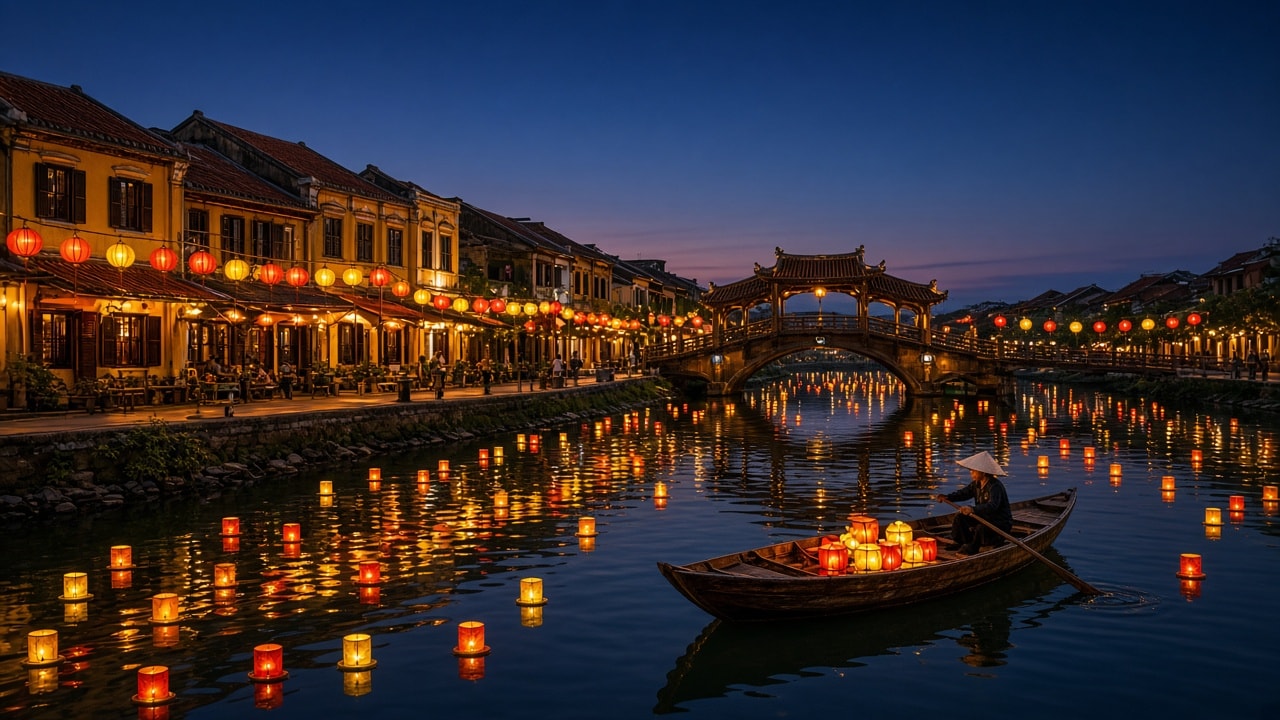
Photoreal blue-hour shot of an old-town river: ochre shophouses with lantern-hung eaves on the left bank, a wooden arched footbridge with a tiled roof pavilion, many floating paper lanterns with shimmering reflections, and a rowboat with a rower in a conical hat carrying glowing lanterns. Step 2 of the Hoi An Lantern River workflow.
A calm river runs through a historic Vietnamese old town at blue hour, its dark water covered with glowing floating paper lanterns while a small wooden rowboat carrying lanterns glides in the foreground. Along the LEFT bank stands a row of yellow ochre two-story shophouses with dark wooden shutters and terracotta tile roofs, with a long riverside promenade and low stone river wall in front, cafe tables, and a few small people strolling; strings of round glowing silk lanterns in red, orange, and yellow hang along the shopfront eaves. In the center background, a wooden arched footbridge with a small tiled pagoda-style roof pavilion at its top spans the river, lit by lanterns, its arch reflected in the water. On the far RIGHT bank, more low buildings with a line of lanterns along the far promenade. Many small square paper lanterns glowing red, orange, yellow, and white float on the calm water, spread from the foreground left all the way to the bridge, each with a long shimmering reflection. In the right-center foreground, a narrow dark wooden rowboat lies diagonally, its left end lower and closer to the camera; one rower in a white conical hat and dark clothes sits at the right end holding a long wooden oar that reaches down into the water toward the lower right, and the middle of the boat carries a pile of about ten glowing paper lanterns. Deep blue twilight sky with a soft pink-violet glow on the horizon behind the bridge, no stars and no moon. Warm lantern light against cool blue dusk, photoreal cinematic travel photography, calm and magical mood. Wide landscape 16:9. No close-up faces, no text, no signs, no logos.
Animate the step 2 lantern river image as the first frame into a calm 6-second shot: the rower pulls the oar and the lantern-laden boat glides toward the lower right, floating lanterns drift and flicker, reflections shimmer, eave lanterns sway, the sky deepens, and the camera slowly pushes in. Step 3 of the Hoi An Lantern River workflow.
Start from the step 2 image "Lantern-Lit Old Town River with a Roofed Footbridge and a Rowboat at Dusk" as the exact first frame, and animate it into a calm 6-second cinematic shot. Keep the yellow ochre shophouses with their lantern-hung eaves on the left bank, the wooden arched footbridge with its tiled roof pavilion in the center background, the far right bank, the deep blue twilight sky with its pink-violet glow behind the bridge, and the framing exactly as in the image. In the right-center foreground, the rower in the white conical hat slowly pulls the long wooden oar and the narrow wooden rowboat with its pile of glowing paper lanterns glides gently toward the lower right, leaving soft spreading ripples on the dark water; the rower stays seated at the right end of the boat. The many floating paper lanterns drift slowly downstream and bob gently on the water, their candle flames flickering and their long reflections shimmering. The round lanterns along the shophouse eaves sway slightly in a light breeze, a few small people stroll along the promenade, and the twilight sky deepens a little. The camera makes one very slow, steady push-in toward the bridge. Natural, realistic motion, no cuts, no new objects, no text. Soft water lapping, the quiet splash of the oar, and distant evening murmurs.Build an image-ready and motion-ready brief for one hero shot of a red-roofed white church on a grassy headland above an Icelandic black sand beach with basalt sea stacks at golden hour: church, beach and surf, sea stacks, light, fixed details, a motion map, and two prompt seeds: a 16:9 still image and an image-to-video animation.
Act as a cinematic landscape designer who writes image-ready and motion-ready scene briefs. Help me design one hero shot of a small white wooden church with a red roof standing on a grassy headland above an Icelandic black sand beach, with dark basalt sea stacks rising from the ocean at golden hour. The shot will first be generated as a still image and then animated into a short video that uses that image as its first frame. Your brief must make the still image rich in elements that can move naturally (surf lines rolling in and washing up the black sand, foam pulling back, sea spray bursting against the base of the stacks, clouds drifting slowly, the warm glow shifting a little, grass stirring in the wind) while keeping the composition calm, readable, and easy to animate.

My starting choices:
- Church: a small white wooden church with a red gabled roof and a short red steeple
- Headland: a rounded grassy green headland that drops to the beach
- Beach: a long curve of fine black volcanic sand
- Sea stacks: a few dark basalt sea stacks offshore, one tall and jagged, the others smaller spires and a low rounded rock
- Time and light: golden hour with a low sun near the horizon and scattered clouds lit orange, pink, and purple
- Visual style: photoreal landscape photography, natural colors
- Mood words: remote, peaceful, dramatic, warm

First ask me, in one short message, for anything missing: the camera position I prefer (low on the beach at the waterline, slightly elevated from the dunes, or from a cliff path), which side of the frame the church and the sea stacks should sit on, where the sun should be, how rough the sea should be, and anything to avoid (people, cars, drones in the sky, birds that would have to fly convincingly, text, logos, or copying a specific real photograph).

Then produce the brief with these sections:

1. **Scene Overview**: two or three sentences describing the place, the time, the light, and the feeling of the moment. Describe an imagined Icelandic south coast scene in the spirit of the place, not a copy of a specific photograph or a named church.

2. **Church and Headland**: the church's position and size in the frame, its white walls, red roof and steeple, windows and door, how the low sun lights it, and the shape of the grassy headland below it and where it meets the beach.

3. **Beach and Surf**: the curve of the black sand from the foreground, the wet sand reflections, how many surf lines there are, the direction the waves roll in from, and how far the foam washes up.

4. **Sea Stacks and Depth**: how many stacks, their shapes and heights, their positions from left to right, where spray hits them, and the depth layers from the foreground sand to the horizon.

5. **Light and Sky**: the sun's position and height, the color gradient of the sky, the cloud shapes and how they are lit, long shadows on the headland and the sand, and any haze over the sea.

6. **Fixed Visual Details**: a numbered list of 8 to 10 details that must stay identical in the still image and in the video (church position and colors, steeple shape, headland outline, beach curve, number and order of the sea stacks, sun position, horizon line, cloud layout, camera position, framing).

7. **Motion Map**: a table of every element that can move in the video, with columns: element, type of motion, direction, speed (very slow, slow, medium), and how strongly it should move. Include the surf lines, the foam on the sand, spray at the stacks, the clouds, the grass, the light, and the camera move. Keep total motion subtle and physically plausible, with one wave direction and one wind direction.

8. **Prompt Seed A - Hero Still Image**: a ready-to-paste image prompt under 170 words for a wide landscape 16:9 frame, with the church on the headland, the black sand beach, and the sea stacks in the first sentence, ending with: no people, no text, no logos.

9. **Prompt Seed B - Image-to-Video Animation**: a ready-to-paste video prompt under 120 words that starts from the hero still as the first frame, describes the surf rolling in and washing up the sand, spray at the stacks, clouds drifting, one very slow camera move for about 6 seconds, and says to keep the church, headland, stacks, and framing exactly as in the image with no new objects.

Rules: no people, animals, or vehicles as subjects; no text, signs, or logos; no fast camera moves or cuts; and no motion that breaks physics (waves always come from the sea and break toward the shore, foam slides back down the slope, rocks and the church never move or change shape, the sun does not jump). Use short paragraphs and lists.
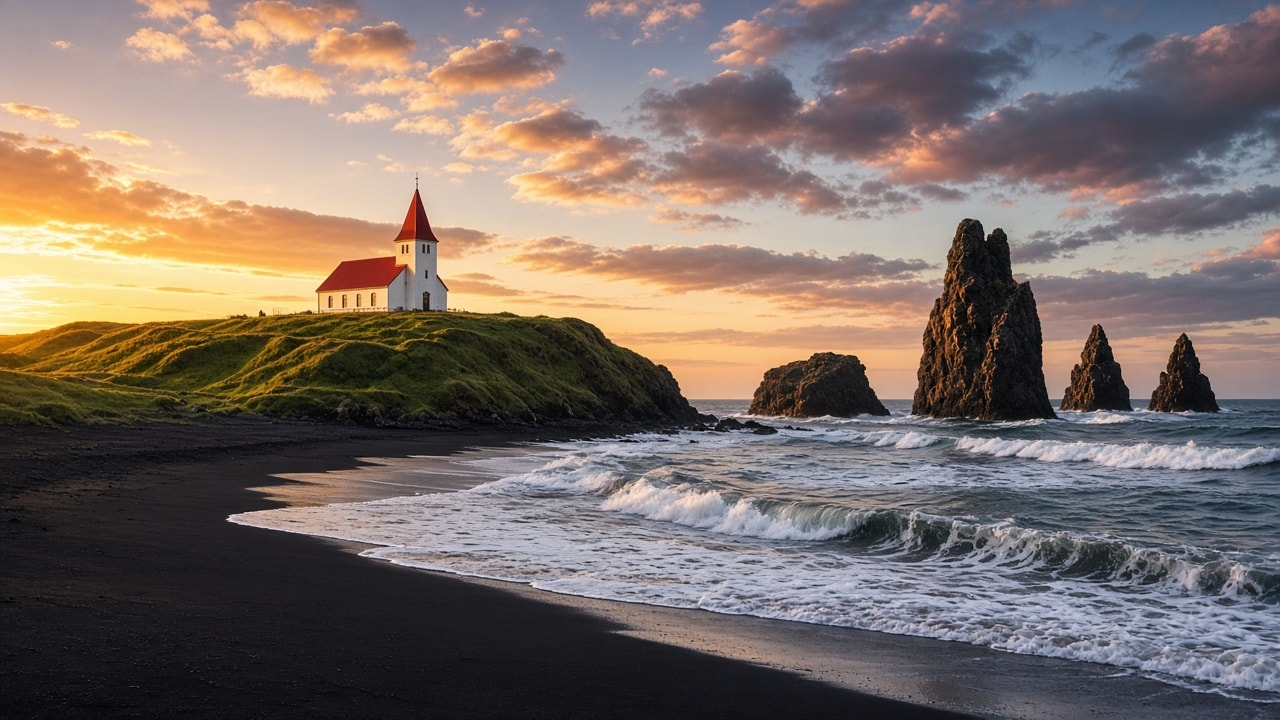
Photoreal golden-hour landscape: a small white church with a red roof and steeple on a grassy headland in the left third, a curve of glossy black sand, white surf rolling in from the right, four dark basalt rocks and sea stacks offshore, a low sun at the far left, and orange, pink, and purple clouds. Step 2 of the Icelandic Black Sand Beach Church workflow.
A small white wooden church with a red gabled roof and a pointed red steeple stands on a rounded grassy green headland above an Icelandic black sand beach at golden hour, with dark basalt sea stacks rising from the ocean on the right. The church sits in the left third of the frame, near the top of the headland, its white walls and small windows lit warm gold by the low sun. The headland's grassy slope drops down to the beach, and a wide curve of fine black volcanic sand sweeps from the lower left corner across the foreground, wet and glossy near the water. White foamy surf rolls in from the right in several long lines and washes up the black sand. In the sea on the right half stand four dark basalt rocks: a low rounded rock near the end of the headland, a tall jagged sea stack in the center right, and two smaller pointed spires further right. The low sun sits near the horizon at the far left behind the headland, glowing yellow-orange, and the sky is filled with scattered clouds lit orange, pink, and purple against soft blue. Photoreal landscape photography, wide angle, natural colors, calm and dramatic mood. Wide landscape 16:9. No people, no text, no logos.
Animate the step 2 black sand beach church image as the first frame into a calm 6-second shot: surf rolls in from the right and washes up the black sand, spray bursts against the tall sea stack, clouds drift while the golden glow holds, grass stirs, and the camera makes a very slight push-in. Step 3 of the Icelandic Black Sand Beach Church workflow.
Start from the step 2 image "White Church with a Red Roof Above a Black Sand Beach and Basalt Sea Stacks at Golden Hour" as the exact first frame, and animate it into a calm 6-second cinematic shot. Keep the white church with its red roof and steeple on the grassy headland in the left third, the curve of black sand, the four basalt rocks and sea stacks on the right, the low sun at the far left, the horizon line, and the framing exactly as in the image. Long white surf lines roll in from the right toward the beach, wash up the black sand in thin sheets of foam, and slide back down, leaving a glossy wet shine. Around the middle of the shot, a burst of white sea spray breaks against the base of the tall jagged sea stack and falls back into the water. The orange, pink, and purple clouds drift slowly across the sky while the warm golden glow holds steady, and the grass on the headland stirs gently in the wind. The camera stays almost still, with only a very slight, slow push-in. Natural, realistic motion, no cuts, no people, no new objects, no text. Sound of rolling surf, wind, and distant waves.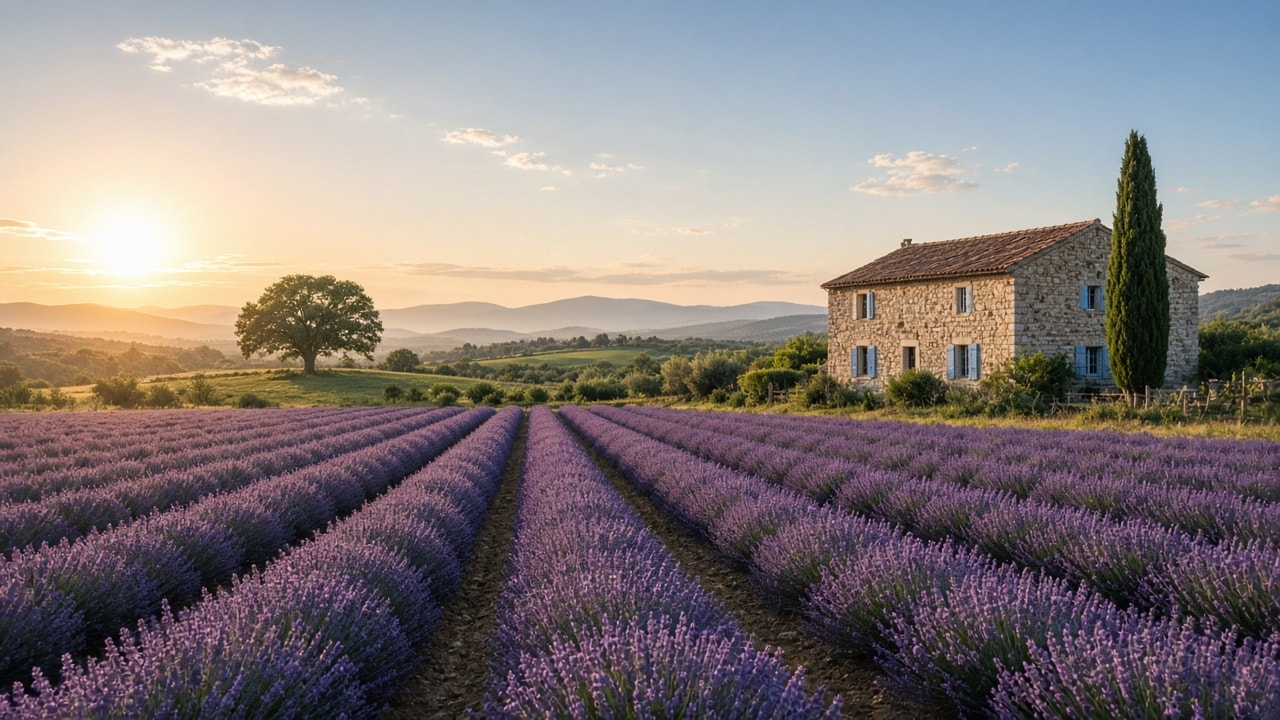
Photoreal sunrise landscape: long purple lavender rows converging along a central dirt path toward a two-story stone farmhouse with a terracotta roof and pale blue shutters in the right third, a tall cypress beside it, a lone oak on the left, a low sun at the far left, and rolling blue hills. Step 2 of the Provence Lavender Farmhouse workflow.
Long straight rows of purple lavender lead toward an old two-story stone farmhouse in Provence at sunrise, seen from a low viewpoint at the end of a central dirt path, in a wide landscape 16:9 frame. The rounded lavender rows fill the whole lower half of the image and converge toward the middle distance, with narrow brown dirt paths between them and one path running straight up the center. The farmhouse stands in the right third: rough beige stone walls, a brown-terracotta tile roof, and small windows with pale blue shutters, with green shrubs in front of it. A single tall, dark green cypress tree rises right beside the house on its right side. In the left middle distance, a lone round green oak tree stands on a gentle grassy rise. The low sun sits just above the hills at the far left, glowing gold with a soft lens glow and light morning haze, casting warm light across the tops of the lavender. Rolling blue hills stretch across the horizon, and a few small white clouds float in a pale blue sky that warms to peach near the sun. Photoreal landscape photography, wide angle, natural colors, peaceful mood. No people, no text, no logos.
Build an image-ready and motion-ready brief for one hero shot of an old stone farmhouse at the end of purple lavender rows in Provence at sunrise: farmhouse and trees, lavender rows, landscape depth, light, fixed details, a motion map, and two prompt seeds: a 16:9 still image and an image-to-video animation.
Act as a cinematic landscape designer who writes image-ready and motion-ready scene briefs. Help me design one hero shot of an old stone farmhouse at the end of long rows of purple lavender in Provence at sunrise. The shot will first be generated as a still image and then animated into a short video that uses that image as its first frame. Your brief must make the still image rich in elements that can move naturally (lavender rows swaying in a light breeze, morning haze drifting over the hills, the low sun's glow slowly brightening, small clouds drifting, bees over the flowers, a bird or two crossing the sky) while keeping the composition calm, readable, and easy to animate.

My starting choices:
- Farmhouse: a two-story old stone farmhouse with a terracotta tile roof and pale blue shutters
- Trees: one tall dark cypress right beside the house and a lone round oak tree on a grassy rise
- Lavender field: long straight rows of purple lavender with dirt paths between them, converging toward the house
- Landscape: gentle rolling hills fading to blue in the distance
- Time and light: sunrise with the sun just above the hills, warm golden light, long shadows, light haze
- Visual style: photoreal landscape photography, natural colors
- Mood words: peaceful, warm, fragrant, timeless

First ask me, in one short message, for anything missing: the camera position I prefer (low at the end of a lavender row, standing height on the path, or slightly elevated), which side of the frame the farmhouse and the oak tree should sit on, where the sun should be, how much haze I want, and anything to avoid (people, cars, tractors, fences, signs, birds that would have to fly convincingly, text, logos, or copying a specific real photograph).

Then produce the brief with these sections:

1. **Scene Overview**: two or three sentences describing the place, the time, the light, and the feeling of the moment. Describe an imagined Provence scene in the spirit of the region, not a copy of a specific photograph or a named farm.

2. **Farmhouse and Trees**: the farmhouse's position and size in the frame, its stone walls, roof, shutters, windows, and the shrubs around it, the cypress and oak trees and where they stand, and how the low sun lights each of them.

3. **Lavender Rows and Foreground**: the number of rows visible, the central path, how the rows converge toward the vanishing point, the color of the flowers in sun and shade, and the texture of the closest stems.

4. **Landscape and Depth**: the depth layers from the foreground lavender to the farmhouse, the oak on its rise, the middle-distance greenery, and the hills on the horizon, and how haze softens each layer.

5. **Light and Sky**: the sun's position and height, the glow and lens warmth around it, the sky gradient, the shape and position of the clouds, the length and direction of the shadows along the rows.

6. **Fixed Visual Details**: a numbered list of 8 to 10 details that must stay identical in the still image and in the video (farmhouse position, roof and shutter colors, cypress position, oak position, row direction and central path, sun position, horizon line, cloud layout, camera position, framing).

7. **Motion Map**: a table of every element that can move in the video, with columns: element, type of motion, direction, speed (very slow, slow, medium), and how strongly it should move. Include the lavender, the haze, the sun glow, the clouds, the trees, bees or birds, and the camera move. Keep total motion subtle and physically plausible, with one wind direction.

8. **Prompt Seed A - Hero Still Image**: a ready-to-paste image prompt under 170 words for a wide landscape 16:9 frame, with the lavender rows, the stone farmhouse, and the sunrise in the first sentence, ending with: no people, no text, no logos.

9. **Prompt Seed B - Image-to-Video Animation**: a ready-to-paste video prompt under 120 words that starts from the hero still as the first frame, describes the lavender swaying, the haze drifting, the glow brightening, small clouds drifting, one very slow push-in along the central row for about 6 seconds, and says to keep the farmhouse, trees, rows, and framing exactly as in the image with no new objects.

Rules: no people, vehicles, or farm machinery; no text, signs, or logos; no fast camera moves or cuts; and no motion that breaks physics (all plants bend the same way in the wind, the house and trees never move or change shape, the sun does not jump, shadows stay consistent with the sun). Use short paragraphs and lists.
Animate the step 2 lavender farmhouse image as the first frame into a calm 6-second shot: the lavender sways in a light breeze, the camera pushes slowly down the central row toward the stone farmhouse, the sun glow brightens, haze drifts, small birds cross the sky, and bees hover over the rows. Step 3 of the Provence Lavender Farmhouse workflow.
Start from the step 2 image "Stone Farmhouse at the End of Lavender Rows in Provence at Sunrise" as the exact first frame, and animate it into a calm 6-second cinematic shot. Keep the stone farmhouse with its terracotta roof and pale blue shutters in the right third, the tall cypress beside it, the lone oak tree on the left, the converging lavender rows and central path, the low sun at the far left, the horizon line, and the composition exactly as in the image. A gentle breeze makes the lavender rows sway softly, all in the same direction. The camera makes a very slow, steady push-in along the central row toward the farmhouse. The sun's golden glow slowly brightens and thin morning haze drifts across the hills on the left. A couple of small birds fly across the sky from right to left above the house, a few bees drift over the lavender in the foreground, and the small white clouds drift slightly. Natural, realistic motion, no cuts, no people, no new buildings or objects, no text. Soft sound of a light breeze, distant birdsong, and buzzing bees.Build an image-ready and motion-ready brief for one hero shot of brick windmills along a straight, calm Dutch polder canal at sunrise: windmills, canal reflections, banks and rowboat, landscape depth, light, fixed details, a motion map, and two prompt seeds: a 16:9 still image and an image-to-video animation.
Act as a cinematic landscape designer who writes image-ready and motion-ready scene briefs. Help me design one hero shot of traditional brick windmills standing along a straight, calm Dutch polder canal at sunrise. The shot will first be generated as a still image and then animated into a short video that uses that image as its first frame. Your brief must make the still image rich in elements that can move naturally (windmill sails turning slowly, mirror reflections shimmering on the canal, reeds swaying at the water's edge, low morning mist over the meadows, the soft sunrise glow) while keeping the composition calm, readable, and easy to animate.

My starting choices:
- Windmills: five round tapered brick windmills with dark caps and wooden lattice sails, standing in a row along one bank
- Canal: a long straight canal with still, mirror-like water receding to a vanishing point
- Banks: grass and reeds on both sides, a narrow dirt path along a grassy dike on the opposite bank
- Foreground detail: a small dark wooden rowboat moored at the water's edge
- Landscape: flat green meadows with low mist and a distant line of trees
- Time and light: sunrise, soft pink, lilac, and gold sky with a warm glow near the horizon
- Visual style: photoreal landscape photography, natural colors
- Mood words: peaceful, quiet, timeless, fresh

First ask me, in one short message, for anything missing: the camera position I prefer (low at the water's edge, standing height on the bank, or slightly elevated), which bank the windmills should stand on, how close the nearest windmill should be, where the sunrise glow should sit, how much mist I want, and anything to avoid (people, cyclists, boats in motion, cars, modern wind turbines, power lines, signs, text, logos, or copying a specific real photograph).

Then produce the brief with these sections:

1. **Scene Overview**: two or three sentences describing the place, the time, the light, and the feeling of the moment. Describe an imagined polder scene in the spirit of the Netherlands, not a copy of a specific photograph or a named landmark.

2. **Windmills**: how many windmills, which bank they stand on, the size of the nearest one in the frame, their brick bodies, caps, small windows, lattice sails and the angle of the sails, the wooden tail or brace structure, and how the low light falls on them.

3. **Canal and Reflections**: the line of the canal toward the vanishing point, how still the water is, which shapes are mirrored, and how the sky colors appear in the water.

4. **Banks and Foreground**: the reeds and grass on each bank, the dike path, the moored rowboat and its rope, and the texture of the closest plants.

5. **Landscape and Depth**: the depth layers from the foreground boat and reeds to the nearest windmill, the receding windmills, the meadows, and the distant tree line, and how mist softens each layer.

6. **Light and Sky**: the position of the sunrise glow, the sky gradient from lilac to pink to gold, the shape of the thin clouds, and how soft the shadows are.

7. **Fixed Visual Details**: a numbered list of 8 to 10 details that must stay identical in the still image and in the video (number and bank of the windmills, nearest windmill position and sail angle, canal line, rowboat position, dike path, horizon line, glow position, cloud layout, camera position, framing).

8. **Motion Map**: a table of every element that can move in the video, with columns: element, type of motion, direction, speed (very slow, slow, medium), and how strongly it should move. Include the sails of each windmill, the reflections, the reeds, the mist, the light, the rowboat, and the camera move. Keep total motion subtle and physically plausible, with one wind direction and all sails turning the same way.

9. **Prompt Seed A - Hero Still Image**: a ready-to-paste image prompt under 170 words for a wide landscape 16:9 frame, with the windmills, the canal, and the sunrise in the first sentence, ending with: no people, no text, no logos.

10. **Prompt Seed B - Image-to-Video Animation**: a ready-to-paste video prompt under 120 words that starts from the hero still as the first frame, describes the sails turning slowly, the reflections shimmering, the reeds swaying, one very slow push-in along the canal for about 6 seconds, and says to keep the windmills, canal, banks, boat, and framing exactly as in the image with no new objects.

Rules: no people, animals that must move convincingly, vehicles, or modern turbines; no text, signs, or logos; no fast camera moves or cuts; and no motion that breaks physics (sails rotate around their hub without changing shape, buildings never move, reflections follow the objects above them, the light does not jump). Use short paragraphs and lists.
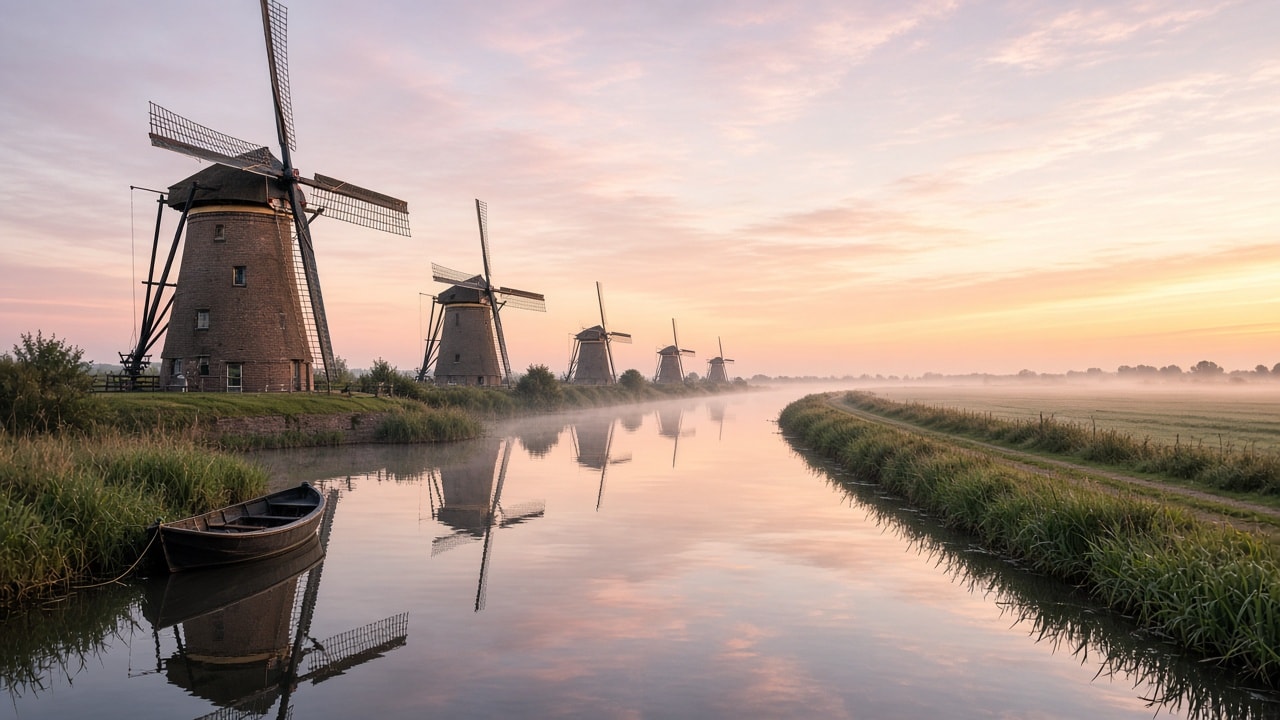
Photoreal sunrise landscape: five brick windmills with dark caps and lattice sails in a row along the left bank of a straight, mirror-calm polder canal, the nearest one large on the left with a wooden tail brace, a small wooden rowboat moored lower left, a grassy dike path with reeds on the right, low mist over the meadow, and a pink, lilac, and gold sky. Step 2 of the Dutch Windmill Canal workflow.
Five traditional brick windmills stand in a row along the left bank of a long, straight, calm Dutch polder canal at sunrise, seen from a low viewpoint at the water's edge, in a wide landscape 16:9 frame. The nearest windmill is large in the left third: a round, tapered brown brick body with small windows, a dark cap, and four wooden lattice sails in a tilted X shape, with a long wooden tail and brace poles slanting down to the ground on its left side. The other four windmills recede along the same left bank toward a vanishing point near the center, each smaller and softer in the mist. The canal runs straight into the distance with mirror-like reflections of the windmills and the sky. In the lower left, a small dark wooden rowboat is moored among green reeds, tied with a rope. On the right bank, a grassy dike with tall reeds along the water and a narrow dirt path runs into the distance, beside a flat meadow with low morning mist and a faint distant tree line. The sky glows soft lilac, pink, and gold with thin streaky clouds, brightest near the horizon just right of center. Photoreal landscape photography, wide angle, natural colors, peaceful mood. No people, no text, no logos.
Animate the step 2 Dutch windmill canal image as the first frame into a calm 6-second shot: the nearest windmill's lattice sails turn clearly while the distant sails turn too, the camera pushes slowly along the canal, reflections shimmer, reeds sway, the moored rowboat stays still, and the soft pink and gold sunrise light holds. Step 3 of the Dutch Windmill Canal workflow.
Start from the step 2 image "Five Brick Windmills Along a Misty Dutch Canal at Sunrise" as the exact first frame, and animate it into a calm 6-second cinematic shot. Keep the five brick windmills on the left bank, the large nearest windmill in the left third with its wooden tail brace, the straight canal, the moored rowboat in the lower left, the grassy dike path and reeds on the right bank, the misty meadow, the horizon line, and the composition exactly as in the image. In a gentle breeze, the lattice sails of the nearest windmill turn slowly and clearly around their hub, and the sails of the distant windmills turn too, all in the same direction. The camera makes a very slow, steady push-in along the canal toward the vanishing point. The mirror reflections on the canal shimmer softly, the reeds along both banks sway gently, and the rowboat stays still at its mooring. The light stays a soft pink and gold sunrise glow. Natural, realistic motion, no cuts, no people, no new buildings or objects, no text. Soft sound of a light breeze, creaking sails, and distant birdsong.