
Photoreal golden-hour landscape: a small white church with a red roof and steeple on a grassy headland in the left third, a curve of glossy black sand, white surf rolling in from the right, four dark basalt rocks and sea stacks offshore, a low sun at the far left, and orange, pink, and purple clouds. Step 2 of the Icelandic Black Sand Beach Church workflow.
A small white wooden church with a red gabled roof and a pointed red steeple stands on a rounded grassy green headland above an Icelandic black sand beach at golden hour, with dark basalt sea stacks rising from the ocean on the right. The church sits in the left third of the frame, near the top of the headland, its white walls and small windows lit warm gold by the low sun. The headland's grassy slope drops down to the beach, and a wide curve of fine black volcanic sand sweeps from the lower left corner across the foreground, wet and glossy near the water. White foamy surf rolls in from the right in several long lines and washes up the black sand. In the sea on the right half stand four dark basalt rocks: a low rounded rock near the end of the headland, a tall jagged sea stack in the center right, and two smaller pointed spires further right. The low sun sits near the horizon at the far left behind the headland, glowing yellow-orange, and the sky is filled with scattered clouds lit orange, pink, and purple against soft blue. Photoreal landscape photography, wide angle, natural colors, calm and dramatic mood. Wide landscape 16:9. No people, no text, no logos.
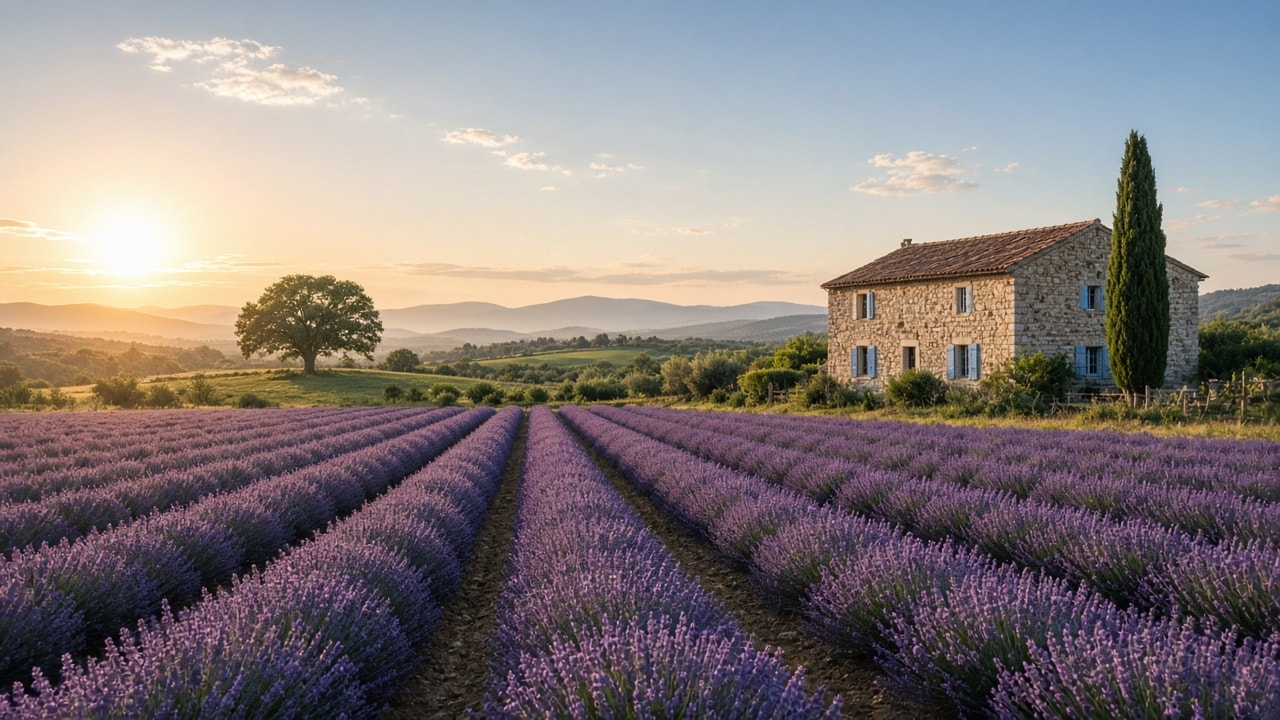
Photoreal sunrise landscape: long purple lavender rows converging along a central dirt path toward a two-story stone farmhouse with a terracotta roof and pale blue shutters in the right third, a tall cypress beside it, a lone oak on the left, a low sun at the far left, and rolling blue hills. Step 2 of the Provence Lavender Farmhouse workflow.
Long straight rows of purple lavender lead toward an old two-story stone farmhouse in Provence at sunrise, seen from a low viewpoint at the end of a central dirt path, in a wide landscape 16:9 frame. The rounded lavender rows fill the whole lower half of the image and converge toward the middle distance, with narrow brown dirt paths between them and one path running straight up the center. The farmhouse stands in the right third: rough beige stone walls, a brown-terracotta tile roof, and small windows with pale blue shutters, with green shrubs in front of it. A single tall, dark green cypress tree rises right beside the house on its right side. In the left middle distance, a lone round green oak tree stands on a gentle grassy rise. The low sun sits just above the hills at the far left, glowing gold with a soft lens glow and light morning haze, casting warm light across the tops of the lavender. Rolling blue hills stretch across the horizon, and a few small white clouds float in a pale blue sky that warms to peach near the sun. Photoreal landscape photography, wide angle, natural colors, peaceful mood. No people, no text, no logos.
Opinionated conventions for building reliable background job queues and workers.
# Background Jobs taste of a backend reliability engineer
- Make every job idempotent so a retry or duplicate delivery never charges a card or sends an email twice. Confidence: 0.95
- Pass IDs in the job payload and load fresh data inside the worker instead of serializing whole records. Confidence: 0.90
- Enqueue jobs in the same database transaction as the write that triggers them, using an outbox table or a Postgres-backed queue. Confidence: 0.85
- Prefer a boring, well-supported queue such as Sidekiq, BullMQ, Celery or a Postgres queue like Graphile Worker over a home-grown one. Confidence: 0.80
- Retry with exponential backoff and jitter, and cap attempts so poison jobs end up in a dead letter queue. Confidence: 0.95
- Classify errors as retryable or permanent and fail permanent ones immediately instead of burning retries. Confidence: 0.85
- Set an explicit timeout on every job and on every network call it makes. Confidence: 0.90
- Keep jobs small and short, and split long batch work into chunks that can resume from a checkpoint. Confidence: 0.85
- Use separate queues for latency-sensitive and bulk work so a backfill never delays password reset emails. Confidence: 0.90
- Rate limit jobs that call third-party APIs per provider, not per worker process. Confidence: 0.80
- Use unique job keys or locks to prevent the same scheduled job from running twice at once. Confidence: 0.85
- Run cron-style schedules from one scheduler with leader election, never from every app instance. Confidence: 0.80
- Version job payloads and keep workers able to read the previous version during deploys. Confidence: 0.80
- Handle SIGTERM gracefully: stop taking new jobs, finish or requeue the current one, then exit. Confidence: 0.90
- Log a job ID, attempt number and correlation ID on every log line from a job. Confidence: 0.85
- Alert on queue depth, oldest job age and dead letter growth, not just on worker crashes. Confidence: 0.90
- Give the dead letter queue an owner and a documented replay command. Confidence: 0.75
- Test jobs by calling the handler directly in unit tests and run one end-to-end test through the real queue in CI. Confidence: 0.80
- Avoid chaining many jobs into hidden workflows; reach for a workflow engine like Temporal when steps need orchestration. Confidence: 0.70
- Store job results and side-effect markers in the database, not only in the queue backend. Confidence: 0.75

Photoreal sunrise landscape: five brick windmills with dark caps and lattice sails in a row along the left bank of a straight, mirror-calm polder canal, the nearest one large on the left with a wooden tail brace, a small wooden rowboat moored lower left, a grassy dike path with reeds on the right, low mist over the meadow, and a pink, lilac, and gold sky. Step 2 of the Dutch Windmill Canal workflow.
Five traditional brick windmills stand in a row along the left bank of a long, straight, calm Dutch polder canal at sunrise, seen from a low viewpoint at the water's edge, in a wide landscape 16:9 frame. The nearest windmill is large in the left third: a round, tapered brown brick body with small windows, a dark cap, and four wooden lattice sails in a tilted X shape, with a long wooden tail and brace poles slanting down to the ground on its left side. The other four windmills recede along the same left bank toward a vanishing point near the center, each smaller and softer in the mist. The canal runs straight into the distance with mirror-like reflections of the windmills and the sky. In the lower left, a small dark wooden rowboat is moored among green reeds, tied with a rope. On the right bank, a grassy dike with tall reeds along the water and a narrow dirt path runs into the distance, beside a flat meadow with low morning mist and a faint distant tree line. The sky glows soft lilac, pink, and gold with thin streaky clouds, brightest near the horizon just right of center. Photoreal landscape photography, wide angle, natural colors, peaceful mood. No people, no text, no logos.
Opinionated conventions for building secure, scalable realtime features with WebSockets.
# Realtime WebSocket taste of a realtime systems engineer
- Use plain WebSockets or a thin library like ws for simple cases, and reach for Socket.IO only when you need its fallbacks and rooms. Confidence: 0.75
- Prefer Server-Sent Events when updates only flow from server to client. Confidence: 0.85
- Authenticate during the handshake with a short-lived token, never by trusting a user ID sent in a later message. Confidence: 0.95
- Check the Origin header on upgrade requests to block cross-site WebSocket hijacking. Confidence: 0.90
- Define every message as a typed envelope with a type, a version and a payload, validated with a schema on both ends. Confidence: 0.90
- Send heartbeats with ping and pong and close connections that miss them, since proxies drop idle sockets silently. Confidence: 0.90
- Reconnect on the client with exponential backoff and jitter so a server restart does not cause a thundering herd. Confidence: 0.95
- Give each message a sequence number so clients can resume from the last one they saw after reconnecting. Confidence: 0.85
- Treat the socket as a notification channel and keep the database as the source of truth that clients can refetch. Confidence: 0.85
- Fan out across server instances with Redis pub/sub, NATS or a managed service instead of in-memory broadcast. Confidence: 0.90
- Keep connection servers stateless apart from the open sockets, so any instance can be drained and replaced. Confidence: 0.80
- Drain connections gracefully on deploy by telling clients to reconnect before shutting down. Confidence: 0.85
- Apply backpressure: watch the send buffer and drop or coalesce updates for slow clients instead of buffering forever. Confidence: 0.85
- Rate limit incoming messages per connection and cap message size. Confidence: 0.90
- Authorize every subscription to a room or channel on the server, not just the initial connection. Confidence: 0.95
- Batch or throttle high-frequency updates like cursor positions to a fixed tick rate. Confidence: 0.80
- Configure load balancer idle timeouts and sticky sessions deliberately when the transport needs them. Confidence: 0.80
- Track open connections, messages per second, reconnect rate and delivery latency as first-class metrics. Confidence: 0.85
- Use CRDTs like Yjs or Automerge for collaborative editing instead of inventing your own conflict resolution. Confidence: 0.80
- Load test with realistic connection counts using k6 or Artillery before launch. Confidence: 0.80